Light Received / Where Light Stands
The question
Chapter 5 asked where light belongs among the works of the Codex, proposed that it is the medium in which the four pillars are seen, and marked the matter open. By the end of Part Four, three answers were on the table.
- A fifth pillar, beside Calendar, Crystals, Sounds and Symbols.
- The medium in which the four are seen.
- The edge: what happens between each pillar and the person.
The question is walked here through thirteen breaths, in the form One Breath, Read Whole uses: what is seen, what is unseen, and the geometry.
Breath 1 · Genesis · How does it begin?
Seen. The Codex did not begin with light. It began with a breath and a childhood, and eighty-one works were made before light was given a study of its own. In the old accounts light comes very early and never first. In Genesis it is the first thing spoken, by a speaker already there. Robert Grosseteste, about 1225, described the cosmos opening from a single point of light, and placed a first matter with it.
Unseen. In no tradition this study has read is light the source. It is the first thing the source gives.
Geometry. A point, and the first line leaving it.
Breath 2 · Spiral · How does it turn?
Seen. This is the third time the Codex has reached for a fifth pillar. The Monad Codex was first called one, and became the still centre. The Codex of the Star-Breathers has called itself one. Now light.
Unseen. Once already the work has reached for five and settled back to four around one, and a second reach still stands in print. A pattern that returns this way is telling the author something about its own shape.
Geometry. A spiral that returns to the same place, one turn out.
Breath 3 · Vector · Where does it point?
Seen. A pillar stands. A person can go to the Calendar, hold a crystal, sit in a sound, look at a symbol. Light cannot be gone to. It has no place of rest. In physics there is no point of view from which it is still. It exists only as a going from one thing to another.
Unseen. The four pillars are places to stand. Light is a way between.
Geometry. An arrow.
Breath 4 · Mirror · What reflects what?
Seen. Hold each pillar up to light.
- Calendar. A day and a year are cycles of light. Since 1967 the second has been defined by a count of light waves from one kind of atom, and since 1983 the metre by the distance light travels. Time and length are now, by international agreement, measured in light.
- Crystals. A stone's colour is the light it declines. And the force that holds a crystal together is the electric force, whose carrier is light.
- Symbols. A symbol is shaped light arriving at an eye.
- Sounds. Here the mirror shows a gap. Sound is heard in the dark. In experience it owes light nothing. In physics, sound passes because the molecules of the air push on one another, and that push is the same electric force.
Unseen. By the first hand: in physics, the force that light carries runs through all four pillars. In experience, light serves three of them and sound stands free. The "medium" answer of Chapter 5 is true in the laboratory and incomplete in the body.
Geometry. Four points, and one thing touching each.
Breath 5 · Stillness · What is silent or left out?
Seen. One Breath, Read Whole counted the words empty centre 856 times in the works of the Codex, and stated the rule: nothing is allowed to sit there. Light, which never rests, cannot be the still centre.
But consider how any eye is built. At its centre is the pupil, and the pupil is a hole. A room becomes a camera when one small opening is made in a dark wall, as Mozi noted and Ibn al-Haytham showed (Passes 2 and 9). The roof-box at Newgrange is such an opening. Seeing begins with a centre kept empty.
Unseen. This is the hinge of the whole question. The centre is not empty as a lack. It is empty the way a pupil is empty: so that light can pass through.
There is a limit, and it is exact. Make the opening smaller and the image grows sharper, until the opening is so small that the light spreads and the image blurs again. An empty centre can be kept too tightly.
Geometry. A circle with nothing at its centre, and a ray passing through.
Breath 6 · Memory · What does it remember?
Seen. The first book, Breath Awakens, carries a blessing that the author has brought into the works since: Your Love and Truth is universal. Bring this universal love and truth to all. You are in a sacred space for all to be heard and listened to. Its title is The Pillar of Light Invocation.
Unseen. The Codex has had a name for where light stands since its first book. It is a pillar, and there is one of it. The four pillars were named later and stand around. The invocation does not describe a fifth standing among them. It describes a space, and a light in it.
This is the author's own wording, older than the question. The mirror only points to it.
Geometry. A vertical line.
Breath 7 · Return · What keeps coming back?
Seen. One word returned through every part of this study: received. One figure returned through every part of One Breath, Read Whole: two circles and the almond between them.
Unseen. They are the same return. What is received is received in the almond, the shared space, and nowhere else. This favours the third answer: light as what happens at the edge.
Geometry. The vesica.
Breath 8 · Release · What is let go?
Seen. One Breath, Read Whole counted not supported 786 times in the works. The habit of the Codex is to let a claim go when it fails.
Unseen. Two things can be let go here. The first is the fifth pillar. Breaths 2, 3 and 6 all weigh against it. The second is harder: the wish that light be the answer to everything. Breath 4 found sound standing free of it, and Breath 10 will find more.
Geometry. An open hand.
Breath 9 · Echo · Where does it sound beyond itself?
Seen. Ask the traditions where light stands and they answer alike. Plato, in the Republic, says the Sun is not sight and is not the thing seen; it is what lets the one meet the other. The Upanishads speak of a light by which everything else shines. Suhrawardi, in twelfth-century Persia, built a whole philosophy on degrees of light. The early Quakers spoke of a light within every person, which is not the person.
Unseen. None of them makes light one of the things. All of them make it that by which things are met. This favours the second answer, the medium, and it is the answer of the old world.
Geometry. A lamp in a room: not one of the furnishings.
Breath 10 · Shadow · What stands behind it?
Seen. Three shadows.
The first. If light is the medium of the Codex, a person who cannot see would stand outside it. That cannot be right, and the Codex of Sounds already shows it is not. Whatever the answer is, it must not make sight a requirement.
The second. The equation of light with good and dark with bad has done real harm in human history. The Codex has not made it. Its own centre is dark and still, and Pass 10 was given to the dark constellations of the Inca. This should be said plainly wherever light is given a place.
The third. The mirror. An AI asked where light stands, by an author who has just finished a study of light, will tend to give light a high place.
Unseen. The honest form of the "medium" answer is therefore wider than light. What runs through all four pillars is not sight. It is receiving: by eye, ear, skin or hand. Light is the part of that receiving we happen to see by. It is one octave of the answer.
Geometry. A circle half in shadow, and whole.
Breath 11 · Descent · Where does it enter the body and daily life?
Seen. The body answers the question in its own design. We have two eyes, held a hand's width apart. Each sees a flat picture, slightly different from the other. From the difference, the mind makes depth, which is in neither picture. Charles Wheatstone showed this in 1838. Close one eye and most of the depth is gone.
Unseen. Here are the three figures of One Breath, Read Whole in one face: a centre kept empty, which is the pupil; two held apart and facing the same way, which are the eyes; and a third that belongs to neither, which is depth. The Codex's geometry was not laid over the body. The body was already built that way.
Geometry. Two circles, apart, and a third thing between them.
Breath 12 · Dream · What does it hope for?
Seen. The author's hope, in his words: that human experience, as we perceive it, is one with everything. The first hand can go some of the way.
| Sense in which "everything is connected" | Grade | Note |
|---|---|---|
| Our atoms were made in stars and have been in other bodies | established | Physics and chemistry |
| All known life is one family | established | Common descent |
| We breathe one air, made by other lives | established | Pass 8 |
| Every perception is made jointly by a world and a perceiver | established | Colour is in neither alone |
| Each particle is a ripple in a field that fills all space | established | Turning 12 |
| Therefore thought can act at a distance | not supported | Does not follow from any of these |
| Experience of oneness is reported in many traditions | established | That it is reported |
| That such experience shows how things are | beyond test | Neither shown nor refuted |
Unseen. The fourth row is the one that bears on the hope. No one has ever had an experience that was theirs alone. Every sight is a third thing, made at the edge between an eye and a world. In that exact and limited sense, to perceive is already to be joined. Whether the joining goes all the way down is beyond what two hands can reach, and the Codex is right to offer it and not assert it.
Geometry. One field, and a ripple in it.
Breath 13 · Wisdom · What holds when tested, and how does it end?
Seen. Set the three answers against the twelve breaths.
| Answer | For it | Against it |
|---|---|---|
| A fifth pillar | Light has its own practices and its own site | Breaths 2, 3, 6: the Codex keeps four; light does not stand |
| The medium | Breaths 4, 9: physics and the traditions | Breaths 4, 10: sound is free of it; sight must not be required |
| The edge | Breaths 7, 11: where receiving happens | Alone, it does not say where the light comes from |
No one of the three holds alone. Two of them hold together, with the centre.
Unseen. Here is what the thirteen breaths return.
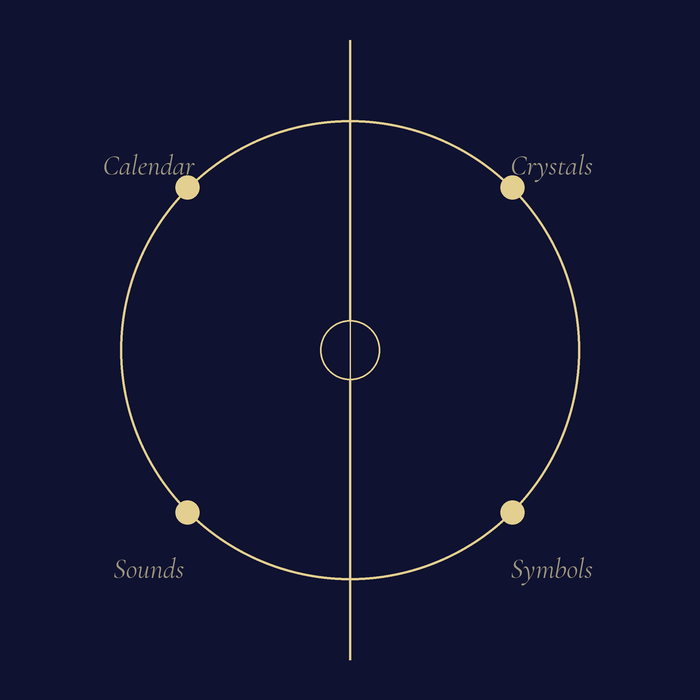
Light is not a fifth pillar, and it is not the centre. The centre is kept empty so that light can pass through it. The four pillars are the surfaces on which it is received. And the receiving happens at the edge between each pillar and a person, where a third is made.
So the Codex has four ways in, one still centre, and one thing that moves between them. The first book named it before the question was asked: a pillar of light, in a space where all can be heard.
Geometry. A circle; four points upon it; a centre left open; and one line of light through the centre.
The author's decision
This is a reading. It was put to the author on 20 November 2026 and he accepted it. Its grade is symbolic, and the author's own, with three exact supports: the pupil, the two eyes, and the rainbow. The proposal of Chapter 5, that light is the medium, is kept in this book as it was first written, as part of the record. It was partly right, and this is what it grew into.
| Claim or reading | Grade | What the evidence shows |
|---|---|---|
| Light is a fifth pillar of the Codex | not supported | Breaths 2, 3 and 6 |
| Light is the medium in which the four are seen | a near-truth | True in physics; incomplete in experience |
| Seeing begins with a centre kept empty | established | The pupil; the pinhole |
| Two eyes held apart make depth, a third | established | Wheatstone, 1838 |
| The centre is kept empty so that light can pass through | symbolic, and the author's own | Accepted 20 November 2026 |
| Light is good and dark is lesser | not supported | The Codex's own centre is dark |
| Sight is required to enter the Codex | not supported | Sound is heard in the dark |
The fourteenth: return to the point
A count that closes begins again. The question the thirteen leave is not about light.
If the centre is kept empty so that something can pass through, what is passing through mine?
Sit in daylight with the Sun out of view. Let the eyes rest half open.
Breathe gently, and never force or hold the breath.
Know that at the centre of each eye is an opening with nothing in it, and that everything you see has come through.
For thirteen easy breaths, let it. Then rest, and breathe normally.