Light Seen / Pass 8
The eighth pass falls under the Release Moon, in Ouon. In the Codex its sign is the labyrinth: the long path walked to a still centre.
The light
The reflection says that bioluminescence is breath-phase coherence expressed as photon emission. Put that way it cannot be tested. But behind it stands a fact that needs no translation: living light is made with oxygen.
The place
The place of this pass is the open ocean below about six hundred feet, where sunlight fades and then fails. It is the largest living space on Earth, and it is not dark. A survey of seventeen years of deep-sea video off California, published in 2017, found that about three-quarters of the animals seen there can make their own light.
What is known
A firefly, a glow-worm, a lantern fish and a glowing mushroom all do the same thing in outline. A small molecule, called a luciferin, is joined to oxygen with the help of an enzyme, and the energy released comes out as light with almost no heat. The details differ from one group to another, because the trick was not inherited from one ancestor. It was found again and again. A review of 2021 counted at least ninety-four separate origins across the tree of life.
Living light is used to find a mate, to lure a meal, to startle a hunter, and to hide. Many deep-sea fish glow faintly along the belly, matching the dim light from above, so that from below they cast no shadow.
In a firefly the link to breath is direct. The light organ is fed with oxygen through fine air tubes. Research published in 2001 pointed to a chemical signal, nitric oxide, that briefly lets oxygen reach the light-making cells. The flash is, in part, a controlled breath.
There is also a far fainter light. Every living cell that uses oxygen gives off a few stray photons as a by-product. It is called ultraweak photon emission, and it is about a thousand times too dim for the eye. In 2009 a team in Japan photographed it rising and falling over the day on the human body. In 2025 physicists at the University of Calgary imaged it across whole mice, alive and then just after death, with the bodies kept warm. The glow dropped sharply when life ended. The authors were plain about what it is. It is chemistry, they said, not an aura: we use oxygen, and we give off a little light.
What is not shown is the larger claim, made since the 1920s, that cells use this light to signal to each other. That remains contested.
What is seen
Sparks in a summer field. A blue wake behind a boat at night.
What is unseen
That the bright lights of the sea and the faint glow of our own skin come from the same root: oxygen reacting with the stuff of life. And that we are ourselves, very slightly, luminous.
The geometry beneath
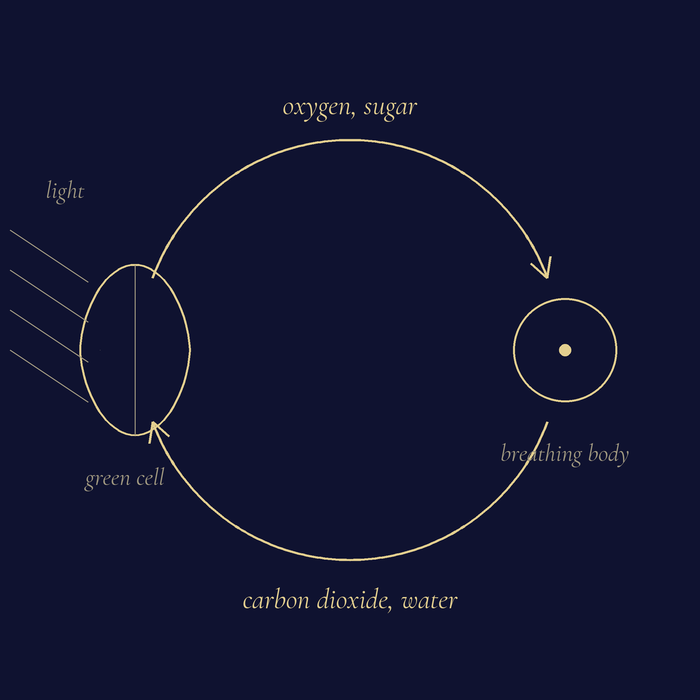
A loop. Green cells take in light, water and carbon dioxide, and give out sugar and oxygen. Animals take in sugar and oxygen and give out water and carbon dioxide. Each side breathes out what the other breathes in. Light enters the loop on the green side and leaves it, here and there, as a firefly's flash or a faint glow on the skin.
| Claim or reading | Grade | What the evidence shows |
|---|---|---|
| Living things make light by a reaction with oxygen | established | The chemistry of luciferins |
| Living light arose independently at least 94 times | established as the current estimate | Lau and Oakley, 2021 |
| About three-quarters of deep-sea animals observed make light | established for the region studied | Martini and Haddock, 2017 |
| A firefly times its flash by gating oxygen | supported, with details still studied | Work since 2001 |
| All living tissue gives off a faint light that fades at death | established as a measurement | Kobayashi, 2009; Salari, 2025 |
| Cells communicate by this faint light | contested | Claimed since the 1920s; not confirmed |
| Bioluminescence is breath-phase coherence as photon emission | symbolic | The reading of the reflection |
Near-truths
- The reflection said living light is breath made visible. In chemistry that is nearly exact. No oxygen, no light.
- The faint glow of the body is not a sign of the soul. It is a sign of burning, and burning is what breath is for.
- Life found light at least ninety-four times, in the dark, without a plan.
Sit near a living plant, indoors or out.
Breathe out slowly toward it, and know that it can use what you give.
Breathe in, and know that the oxygen in this breath was freed by a green cell, somewhere, in the light.
Do this for seven easy breaths.
Rest, and breathe normally.