Light Seen / Pass 7
The seventh pass falls under the Return Moon, in Ouon, stillness. Its sign is the serpent: the coil at rest and the wave in motion.
The light
The serpent is the oldest drawing of a wave. This pass asks what the reflection means when it says that the meeting of two fields creates the light-bearing field.
The place
At Chichen Itza in Yucatan stands the pyramid called El Castillo, raised by the Maya about a thousand years ago. Its north stairway ends at the ground in two carved serpent heads. On the afternoons around the spring and autumn equinoxes, the stepped corner of the pyramid casts a row of triangles of light and shadow down the side of that stairway. They join the head, and for a while a serpent of light seems to lie along the building. The effect is real and thousands gather to see it. Whether the builders planned it is debated, since it shows for several weeks and no Maya text describes it.
What is known
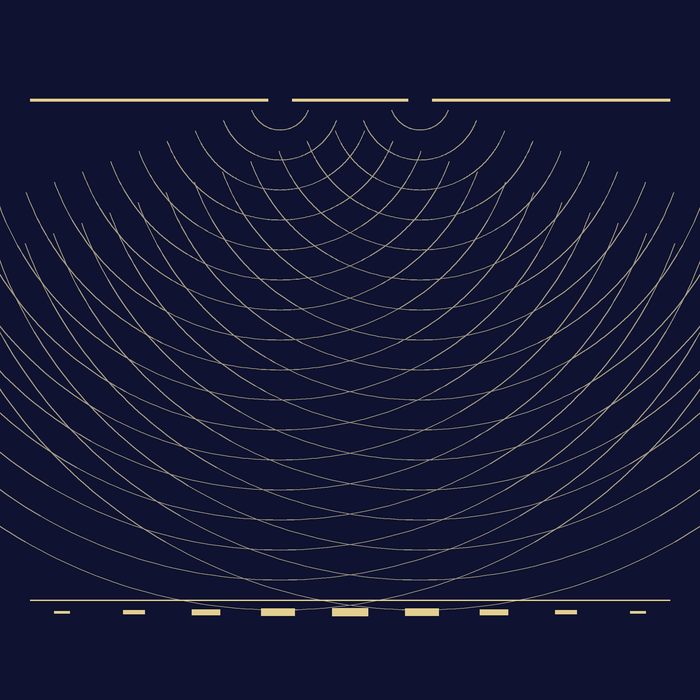
Is light a stream of particles or a wave? Newton leaned toward particles. About 1801 Thomas Young settled the matter for a century with one experiment. He let light from a single source pass through two narrow openings close together and fall on a screen. He did not see two bright patches. He saw a row of bright and dark bands. Where the waves from the two openings arrived in step, they added and gave light. Where they arrived out of step, they cancelled and gave darkness. Light added to light had made dark. Only a wave can do that.
In the twentieth century the experiment was repeated with light so faint that one photon passed at a time. Each photon lands at one spot, like a particle. But as the spots build up, they form the same bands. Each photon behaves as though the wave of it went through both openings.
What is seen
Bands of light and dark on a wall. A serpent of light on a stair.
What is unseen
The dark bands are not places where no light was sent. Light was sent there from both openings, and the two arrivals undid each other. The energy is not lost; it goes to the bright bands.
The geometry beneath
Two sets of circles, spreading from two points and overlapping. The Codex calls the almond-shaped overlap of two circles the vesica. Young's bands are drawn by exactly such an overlap. The meeting of two fields does not create light, which was there already. It creates pattern: an ordered standing figure of light and dark that neither field holds alone.
| Claim or reading | Grade | What the evidence shows |
|---|---|---|
| Light behaves as a wave | established | Young, about 1801; all of optics since |
| Light also arrives as single photons | established | Twentieth-century experiments |
| Light added to light can give darkness | established | Interference |
| A serpent of light appears on El Castillo near the equinoxes | established as an effect | Seen every year |
| The Maya designed the serpent effect | contested | No text records it; the effect is not limited to the equinox |
| The meeting of two breath fields creates the light-bearing field | symbolic | It creates pattern, not light |
Near-truths
- Two fields overlapping do not make light. They make order. The reflection reached for the right figure and gave it the wrong job.
- Darkness in the bands is not absence. It is two presences in disagreement.
- This is the second illumination of One Breath, Read Whole, drawn in light: two that stay whole make a third, and the third belongs to neither.
Fill a wide bowl with water and let it settle.
Touch the surface gently with one fingertip, and watch one breath of rings.
Then touch it with two fingertips, a hand's width apart.
Watch where the rings cross, for five easy breaths.
Rest, and breathe normally.