Light Received / The Skin: Where Sunlight Becomes a Messenger
Two steps, one of light and one of warmth
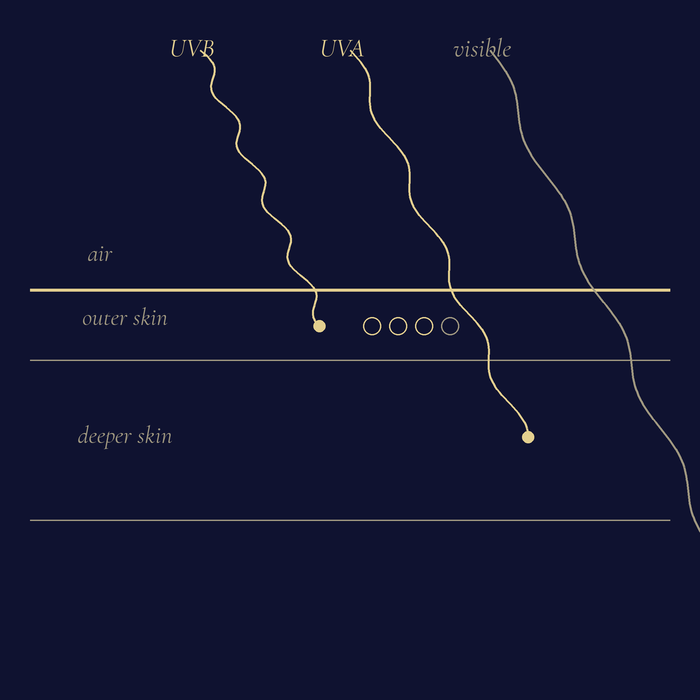
In the membranes of the living cells of the outer skin there waits a close relative of cholesterol. Its working name is 7-dehydrocholesterol. Call it the waiting molecule.
It is built of four rings of carbon. One narrow band of sunlight, the ultraviolet called UVB, carries exactly the energy that this molecule absorbs best. That band is less than a twentieth of the ultraviolet that reaches the ground. When one photon of it is absorbed, one of the four rings breaks open. The result is a new molecule, previtamin D.
Then light's part is over, and the body's begins. Previtamin D is not yet the vitamin. Over the following hours and days, the plain warmth of the skin lets the opened molecule fold itself into its final shape, vitamin D. So the making takes two steps and two givers: a photon to open the ring, and the body's own warmth to finish it. Neither can do the other's part.
The skin cannot be overfilled
There is a second thing of beauty here. If sunlight goes on falling, the previtamin itself absorbs it and is turned into two side-products that do not act as vitamin D. (Whether they have quiet work of their own is under study, and open.) Vitamin D already made is broken down the same way. The skin reaches a balance at which only about a tenth to a seventh of the waiting molecule is converted, however long the exposure. No case of vitamin D poisoning from sunlight is known. Poisoning comes from the bottle. The Sun's gift has a brim built in. The burn has none: skin goes on burning long after it has stopped making vitamin.
From vitamin to messenger
The new molecule leaves the skin in the blood. The liver changes it once, the kidney changes it again, and what results is not a vitamin at all in the strict sense. It is a hormone, a messenger, and nearly every tissue of the body carries the receptor that reads it. Its first and proven work is to let the gut take up calcium, which is why a child without it grows soft and bent bones.
So the full path is this: a photon that left the Sun eight minutes ago opens a ring in the skin; warmth finishes it; two organs refine it; and the message that arrives in the bone says, in effect, build. Light has become an instruction.
How it was found
- 1822. Jędrzej Śniadecki, in Poland, notes that the bone disease rickets is common among city children and rare in the country, and advises sunlight.
- 1919. Kurt Huldschinsky, in Berlin, cures children of rickets with a mercury lamp. Light on one arm heals the other arm too, so something is carried in the blood.
- 1924. Harry Steenbock and Alfred Hess show that food exposed to ultraviolet gains the power to cure rickets.
- 1928. Adolf Windaus receives the Nobel Prize for the chemistry of the sterols that become the vitamin.
- 1980 and 1982. Michael Holick and colleagues find previtamin D in human skin and measure which wavelengths make it. The peak is close to 297 billionths of a metre.
- 1988. The "vitamin D winter" is measured. In Boston, from November to February, the Sun is too low for any to be made.
What changes the making
Latitude and season. The UVB band is the first to be lost when sunlight crosses the air at a slant. Far from the equator, winter sunlight makes none.
The hour. For the same reason, the making is strongest near midday, which is also when burning is quickest.
The skin's own shade. Melanin, the dark pigment, absorbs the same band. Darker skin needs longer in the same Sun. The spread of human skin colours across the Earth is read by many researchers as a balance struck over thousands of generations, between protection where the Sun is fierce and vitamin-making where it is weak. That reading is well supported, and still discussed.
Age. Older skin holds much less of the waiting molecule.
Glass. Window glass stops the UVB band. Sun through a window warms, and makes no vitamin D.
A mushroom does a version of the same thing. Left in the Sun, it turns its own sterol into a form of vitamin D. The chemistry is far older than skin.
What vitamin D does, and what has been claimed for it
Here the two hands are needed, because a great deal has been claimed.
Established: it is needed for bone, and a real lack of it causes rickets in children and soft bones in adults.
Tested and not borne out: that extra vitamin D, given to healthy adults who are not short of it, prevents broken bones, cancer or heart disease. A large American trial of nearly twenty-six thousand people, reported from 2019 to 2022, found no fewer fractures in those who took it. In 2024 the Endocrine Society advised that healthy adults under seventy-five need no more than the ordinary recommended amount, and need no routine testing.
One result that stands out: in that same trial, those who took vitamin D for five years had about a fifth fewer new cases of autoimmune disease. It is one trial, and the grade is promising, not yet settled.
So the vitamin is real, the lack of it is real, and "more is better" is not supported.
Vitamin E: the reflection reversed
The reflection asks whether sunlight on skin also makes vitamin E. It does not, and the grade is not supported. No animal can make vitamin E, in light or in the dark. What is true is stranger and suits the Codex better.
Vitamin E is made by plants, inside the green bodies where they catch light. They make it to protect their own light-catching membranes from the damage that light does. It is a shield made by light-catchers, against light.
We take it in with food. The body carries it to the skin in the skin's own oil, where it sits in the outermost layer. And there sunlight spends it. In a 1998 study under a sun-lamp, a single dose too small to redden the skin used up nearly half of the vitamin E in the outermost layer. In a small 2004 study from a skin-care laboratory, half an hour of real midday Sun used up a half to two thirds of the vitamin E at the skin's surface.
So the two vitamins stand opposite one another at the same boundary:
| Vitamin D | Vitamin E | |
|---|---|---|
| Where it is made | In human skin | In the green leaf |
| What light does to it | Makes it | Spends it |
| What it is | A message: build | A shield: protect |
| What it shows | Light received | The cost of receiving |
Every receiving of light has a price, and life pays it with something that light itself helped to make. That sentence is the honest form of the reflection's guess, and it is graded established in its parts and symbolic as a whole.
There is more: what else the skin makes of light
The reflection says, "There is more here." There is.
A gas that eases the blood vessels. The skin holds a large store of nitrogen compounds. The longer ultraviolet, UVA, releases from them a small gas, nitric oxide, which passes into the blood and widens the arteries. In a 2014 study of twenty-four volunteers, a measured dose of UVA lowered blood pressure for a time, and vitamin D did not change at all. This is a second, separate pathway. That it happens is established in small studies. That it protects health is open: a two-week trial in 2022 found only a brief fall each time.
A pigment that turns light to warmth. Melanin absorbs ultraviolet and turns almost all of it into harmless heat in less than a millionth of a millionth of a second. A tan is the skin building more shade after it has been hurt. Established.
A reward. In mice, ultraviolet on the skin leads its cells to make beta-endorphin, one of the body's own opiates, alongside the signal to tan. The mice came to seek the light. This may be why sunlight feels good, and why some people overdo it. Established in mice, suggestive in people.
A clock. In 2019, light-sensing proteins of the same family as those in the eye were shown to set the daily clock of mouse skin directly, with no help from eye or brain. Human skin carries proteins of this family. What they do in us is open.
A cure for the newborn. Many babies are born yellow, because a waste product called bilirubin has not yet been cleared. In 1956, at a hospital in Essex, a nursing sister, Jean Ward, noticed that babies whose cots stood in the sunlight lost their yellow sooner. Blue light, falling on the skin, changes the shape of the bilirubin molecule so that the body can pass it. The hospital's doctors published it in 1958, and it is done in hospitals every day. Established.
Harm. The same UVB that opens the waiting molecule also damages the cell's inherited instructions. Skin has repair crews for this, and they are good, and they are not perfect. Sunburn is the sign of damage past what could be mended at once. Skin cancer is the long result. Ultraviolet also breaks down folate, a vitamin needed for the making of new cells. Established.
The balance, honestly
For fifty years the public advice in fair-skinned countries has been simple: less Sun. That advice has saved lives from skin cancer and is not to be thrown out.
A second line of evidence has grown beside it. In 2024, researchers followed the records of about 395,000 people in the United Kingdom and found that those with more ultraviolet exposure had lower death rates overall, chiefly from heart disease and cancer. A long Swedish study found the like. These studies watch people; they do not assign them to Sun or shade. People who get more Sun may also walk more, earn more, or be well enough to go out. So the finding is contested, and worth watching: it shows a link and cannot show a cause.
The two-handed position is this. Sunburn is harm, always. A complete absence of Sun is probably also a loss, and not only of vitamin D. Between the two lies a measure that differs with skin, place, season and health, and that each person should settle with their own doctor.
| Claim or reading | Grade | What the evidence shows |
|---|---|---|
| A photon of UVB opens a ring to make previtamin D | established | Measured in human skin |
| Body warmth completes the vitamin | established | A two-step making |
| The Sun cannot overdose the skin with vitamin D | established | Excess is turned into other forms |
| Vitamin D is needed for bone | established | Rickets and its cure |
| Extra vitamin D protects healthy adults from most diseases | not supported | Large trials; 2024 guidance |
| Extra vitamin D lowers autoimmune disease | promising, not settled | One large trial |
| Sunlight makes vitamin E in the skin | not supported | Plants make it; sunlight spends it |
| UVA releases nitric oxide and lowers blood pressure briefly | established in small studies | 2014; a 2022 trial found the effect brief |
| Sunlight on skin makes a natural opiate | established in mice | 2014 |
| Skin sets its own clock by light | established in mice; open in people | 2019 |
| Blue light on skin clears a newborn's jaundice | established | Daily medicine since 1958 |
| More sunlight means longer life | contested | A link, not yet a cause |
| Sunburn is harmless | not supported | It is damage |
Near-truths
- The skin does not only stop light. It reads it, in at least five ways, and answers.
- Vitamin D is light received. Vitamin E is the price of receiving. Both are true at the same surface.
- The Sun's gift to the skin has a brim. Its harm has none. That is reason enough for a short measure.
This is not medical advice. If you have had skin cancer, take medicines that make skin sensitive, or have been told to avoid the Sun, follow that advice.
Otherwise, on a bright day, let the Sun reach your bare forearms or face for a few minutes only. Never look at the Sun. Never stay until the skin reddens.
Breathe gently, and never force or hold the breath.
Know that in these minutes a ring is opening in the skin, and that your own warmth will finish the work tonight.
Step into the shade. Rest, and breathe normally.