Light Seen / Pass 10
The tenth pass falls under the Shadow Moon. In the Codex its sign is the torus: a flow that goes out, around, and back through its own centre.
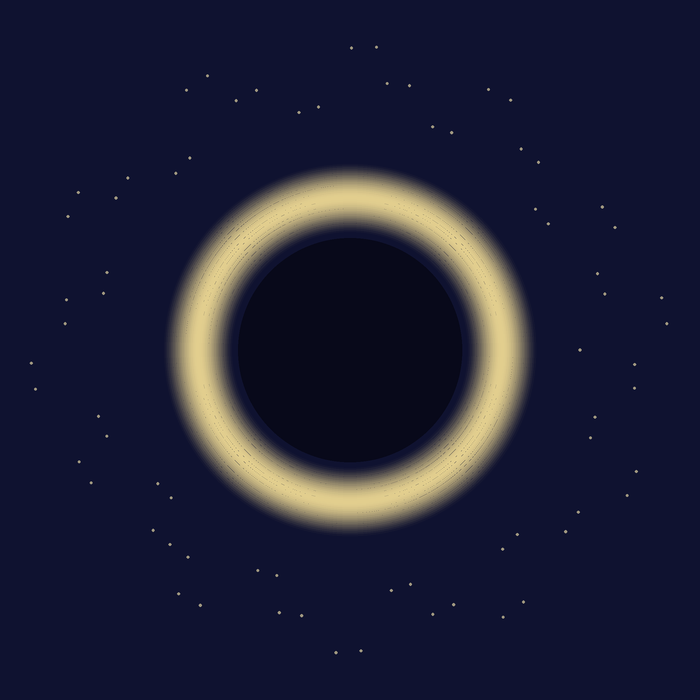
The light
The reflection says that what appears as darkness is often light folded back into itself. As physics that is not supported. But there are four true things near it, and each is stranger.
The place
The Atacama Desert of Chile and the high Andes of Peru have some of the darkest and clearest skies on Earth. The Inca, who lived under those skies, read the heavens in two ways. They named groups of stars, as most peoples have. They also named the dark places. In the black lanes of the Milky Way, where clouds of dust hide the stars behind, they saw a llama with her young, a serpent, a toad, a partridge, a fox. These are the yana phuyu, the dark clouds. Their rising and setting were tied to the seasons of rain and herding. Quechua-speaking communities keep this knowledge still.
What is known
First: most light is unseen. In 1800 William Herschel held a thermometer just beyond the red end of a spectrum and found that it warmed. He had discovered infrared. The next year Johann Ritter found ultraviolet beyond the violet. The eye responds to about one octave of light, a doubling of frequency from deep red to violet. The whole range that instruments now detect, from long radio waves to gamma rays, runs to many dozens of octaves. A dark room is full of light the eye is not built for.
Second: the night sky is dark for a reason. If the universe were endless, unchanging and full of stars, every line of sight would end on a star and the whole sky would blaze. This puzzle is named for Heinrich Olbers, who wrote on it in 1823. The answer is that the universe has an age. Light from the farthest regions has not had time to arrive, and what does arrive from far away has been stretched out of sight. The darkness of night is evidence of a beginning.
Third: there is matter that gives no light at all. Galaxies turn as if they hold about five times more matter than their stars and gas can account for. It is called dark matter. The growth of the universe is speeding up, and the cause is called dark energy. Neither is "folded light". Dark matter neither gives out light nor takes it in, and nobody yet knows what either one is. That is honestly open.
Fourth: there are places light cannot leave. Around a black hole, space is so curved that light itself is held. In 2019 the Event Horizon Telescope, a network of radio dishes spanning the Earth, made the first picture of one. It shows a ring of light around a dark centre. The ring is light from hot gas, bent around the hole. The dark is the hole's shadow.
The torus
The reflection says light fields often take the shape of a torus. Ordinary light does not. But in 1996 two physicists, Hellwarth and Nouchi, found that Maxwell's equations allow a pulse of light shaped like a ring doughnut, with its fields wound around the ring. In 2022 a team in Southampton and their partners made such pulses and measured them. They are rare, difficult, and real.
What is seen
A black sky with points of light. A dark shape in the Milky Way.
What is unseen
Nearly everything. The warmth beyond red, the burn beyond violet, the first light of the universe in every direction, and the dust clouds that the Inca named, which are the places where new stars are forming.
The geometry beneath
The ring. A ring of light around a shadow in the picture of a black hole; a ring of aurora around each of the Earth's magnetic poles; a ring-shaped pulse on a laboratory bench. The torus is not the usual shape of light. It is the shape light takes when something bends it all the way around.
| Claim or reading | Grade | What the evidence shows |
|---|---|---|
| Darkness is light folded back into itself | not supported | Darkness is the absence of light the eye can use |
| Most light is invisible to the eye | established | Herschel, 1800; Ritter, 1801; the whole spectrum |
| The night sky is dark because the universe has an age | established | The resolution of Olbers' puzzle |
| Dark matter and dark energy are hidden light | not supported | They do not emit or absorb light; their nature is open |
| Light near a black hole is bent into a ring | established | Event Horizon Telescope, 2019 |
| Light fields often take the shape of a torus | not supported as "often" | Toroidal pulses were first made in 2022 |
| The Inca read figures in the dark of the Milky Way | established | Recorded in the colonial period and living today |
| The dark is where the next light is prepared | symbolic, with a true echo | Stars do form in the dark clouds |
Near-truths
- Darkness is not light turned inward. It is light we cannot see, light that has not arrived, and, in a few places, light that cannot leave.
- The Inca did not treat the dark as empty. They read it. Science took until the twentieth century to learn that those dark lanes are nurseries of stars.
- The old teachers who spoke of a "dazzling darkness" were not doing physics. They were saying that what exceeds the eye looks, to the eye, like night.
On a clear night, away from lamps if you can, let your eyes rest on the sky for some minutes.
Do not look for stars. Look at a dark place between them.
Let ten easy breaths pass. The eyes will open further on their own.
Notice what the dark begins to hold.
Rest, and breathe normally.